

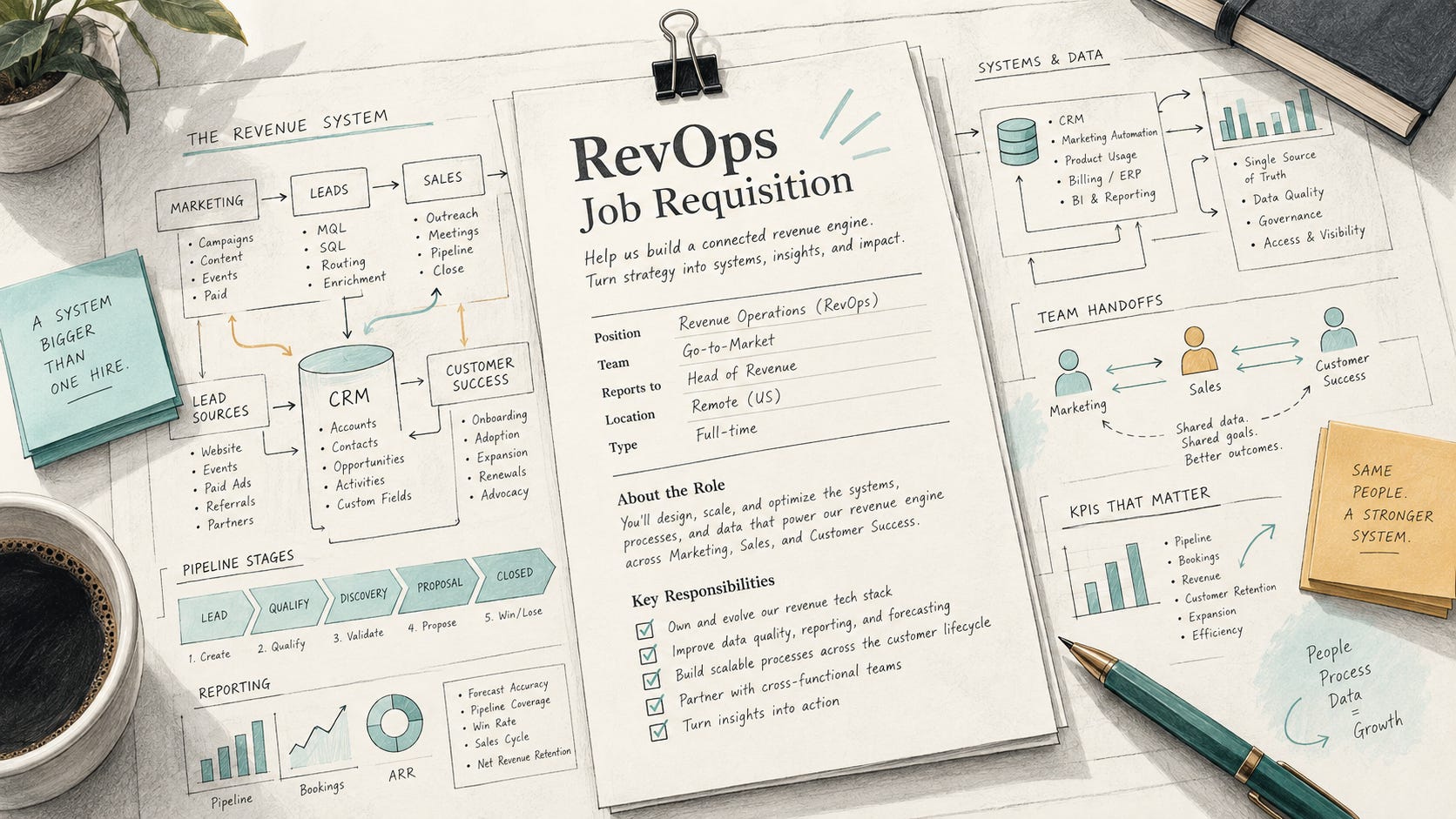
Having RevOps work does not mean you need a RevOps hire
It is easy to find enough RevOps work to keep someone busy in a growing revenue team. The CRM needs attention, forecasting lacks structure, reporting is unreliable, and cross-functional processes have accumulated without clear ownership.
That can make a full-time hire feel obvious. But a large workload does not necessarily create one coherent role. The work may combine one-off fixes, recurring execution, specialist knowledge and senior commercial judgement and they all requiring different levels of expertise.
Hiring before separating those needs can leave you with the wrong profile for a large part of the job. Before opening the role, you need to understand what requires ongoing ownership, what level of judgement it needs, and how much recurring capacity it creates.
That matters because RevOps is a broad function. Its remit can span forecasting, reporting, CRM and data, sales process, tooling and cross-functional handoffs. The work may all sit under RevOps, but it does not necessarily belong to one full-time hire.
1. A single RevOps role cannot cover every type of work
The first RevOps hire often goes wrong when the business treats everything that falls under RevOps as one job.
But RevOps is a function, not a single skill set. The work inside it can require very different levels of seniority, expertise and judgement. Some work requires senior commercial judgement and the ability to shape how the revenue engine operates. Other work depends on specialist technical or analytical expertise, while some is recurring operational work that does not require senior experience.
When all of that is combined into one job description, the company is no longer defining a coherent role. It is asking one hire to cover several different capability requirements at once.
That creates a difficult hiring trade-off. Hire for the most senior and complex work, and a meaningful part of an expensive person’s capacity may be spent on work that does not require their level of experience. Hire for the volume of more operational work, and the person may lack the experience to make the higher-impact decisions the business also expects them to own.
This matters even more when the first hire becomes the entire function. Revenue Operations Alliance’s 2024 research found that 25.58% of respondents were operating as solo RevOps practitioners. With no wider team to absorb the mismatch, one person is expected to cover the full range of responsibilities (source: Revenue Operations Alliance — State of Revenue Operations Report 2024).
Having enough RevOps work to justify a salary does not mean you have one well-designed role. A company can have more than enough reasons for a job opening and still hire for the wrong combination of capabilities.
2. Work out what the business actually needs from RevOps
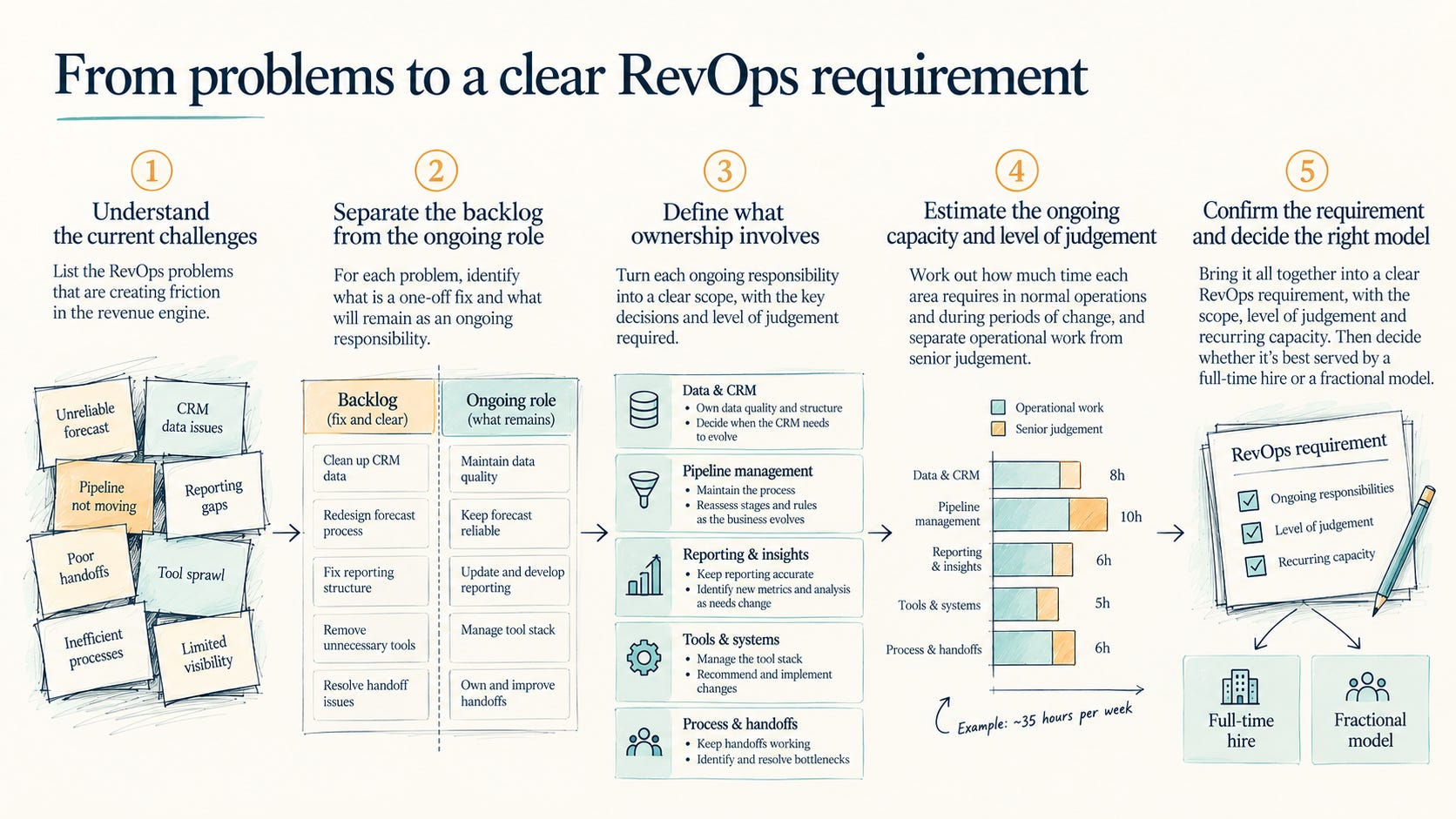
The cleanest way to define the requirement is to work backwards from what the revenue engine needs over the next 12 months. Identify the responsibilities that need ongoing ownership, then the level of judgement and capacity required to support them.
That gives you a clearer basis for the role than today’s backlog and helps separate short-term fixes from long-term needs.
Separate the backlog from the ongoing role
A growing company often considers hiring RevOps when several problems have accumulated at once. That backlog can make the ongoing role look bigger than it really is.
Take an unreliable forecast, as an example. Fixing it may require concentrated work to redesign the process and correct the underlying CRM structure. Once that is done, the requirement changes: someone still needs to keep the forecast reliable as the business evolves. However, that will probably require less capacity than the initial rebuild.
This is the first distinction to make across the RevOps workload. For each significant problem, ask what remains once the immediate fix is complete.
Some work may disappear once the problem is solved. Other work creates a responsibility that needs an owner month after month. That ongoing responsibility is what should start shaping the role.
Define what ownership actually means
Once you know which responsibilities continue, define what ownership actually involves.
Ownership goes beyond completing tasks. It means being accountable for whether that part of the revenue engine continues to work and knowing when it needs to change and that decisions may need different experience levels.
Pipeline management is a good example. One person may maintain the process and keep the CRM aligned with it. A more senior owner may need to question whether the stages still reflect how buyers move through the sales process and redesign them when they do not.
Those responsibilities sit under the same function but require very different levels of judgement. The level of experience you hire for should match the decisions the role is expected to make.
Work out how much ongoing capacity that ownership requires
Once you know which responsibilities need ongoing ownership and what that ownership involves, you can estimate capacity.
Start with the time required during normal operations, then account for heavier periods created by change.
This gives you a clearer picture of how much RevOps capacity the business needs and what level of ownership that capacity must support.
Imagine the business has around 35 hours of RevOps work in a typical week. Perhaps 30 of those hours are relatively operational, while only five require senior RevOps judgement.
Looking only at the total workload, a full-time senior hire can seem obvious. In practice, most of that person’s week would be spent on work that does not require their level of experience.
Hire instead for the 30 operational hours, and you create the opposite problem: the five hours requiring senior ownership are still uncovered.
Total hours tell you how much capacity the business needs. When you separate operational work from responsibilities requiring senior judgement you can better understand what level of RevOps capability the role requires.
What you should have before moving on
By this point, you should be able to answer three practical questions:
Which RevOps responsibilities need ongoing ownership once the current problems are fixed?
What level of judgement does that ownership require?
How much recurring capacity is needed to support those responsibilities?
If you cannot answer those three questions with confidence, the role is not defined well enough yet.
Once you do, you’ll have a much stronger picture of the RevOps capability the business actually needs. The next decision is whether that requirement is best served by someone inside the company full time or through a fractional operating model.
3. Decide which RevOps model fits your business
Once the scope is clear, the next step is to decide how the RevOps role should operate inside the business.
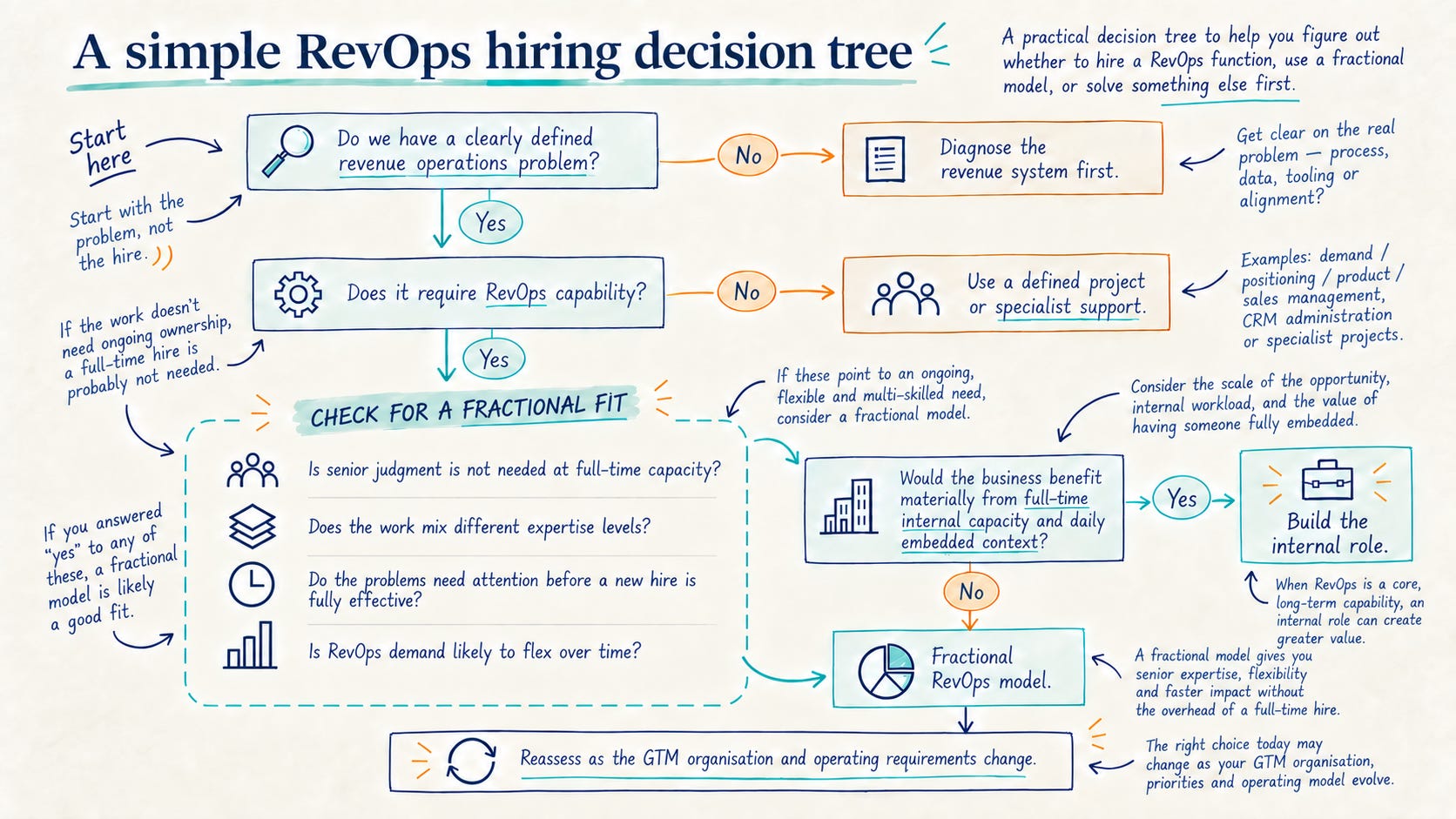
Some companies need a senior RevOps person embedded full time, with ongoing ownership of the function as the business evolves. Others need the same level of senior judgement without requiring five days of internal capacity, making a fractional model more appropriate. And some already have the strategic direction and ownership in place but need third-party support to execute the work.
The right model depends on how much senior judgement needs to stay close to the business and how much execution capacity the work requires.
When full-time RevOps is the right choice
A full-time hire makes more sense when the role depends on continuous context, frequent strategic decisions and close coordination across the commercial team.
The role needs a permanent seat in strategic leadership
Senior RevOps work does not automatically need to sit inside the company. A fractional operator can still challenge the pipeline model, redesign forecasting, shape reporting and advise leadership on how the revenue engine should evolve.
The case for a full-time senior role becomes stronger when RevOps is expected to be part of the company’s leadership structure itself.
The case for a full-time senior hire becomes stronger when RevOps needs to be part of the leadership structure itself. This could mean being involved as strategic decisions are made, contributing to commercial planning and bringing a RevOps perspective into ongoing leadership discussions.
At that point, the value comes from being continuously embedded in the context around those decisions. When that level of involvement is a recurring part of the role and genuinely requires full-week participation, building senior RevOps capability internally makes more sense.
The work depends heavily on daily internal context
A close relationship with the commercial team is not enough to justify a full-time hire. A fractional RevOps partner can still join meetings, advise leaders and stay closely connected to the business.
The stronger case is when there is enough recurring work at the right level of expertise to fill the week. For a senior hire, that may mean continuous involvement in planning, leadership decisions and ownership of the revenue operating model. For a more execution-focused role, it may mean enough systems, reporting and operational work to require dedicated capacity.
What matters is that the role is filled primarily with work that matches the level of person being hired. If senior judgement is needed only for a few hours and the rest of the week is lower-level execution, a different RevOps model may fit better.
You are deliberately building an internal RevOps function
The case for an internal hire becomes stronger when the business is no longer resourcing a single role but deliberately building a RevOps function.
As the commercial organisation grows, RevOps work often separates into areas such as systems and data, planning, analysis and commercial operations. Someone then needs to decide which capabilities belong in the team, where responsibilities sit and when additional capacity should be added.
That changes the profile of the first hire. Alongside hands-on RevOps work, they may need to define roles, hire and manage additional people, and keep the function aligned to the same commercial priorities.
When the business is intentionally building that internal capability, hiring makes more sense because the role carries long-term responsibility for the function itself, not only for the RevOps work being delivered today.
When fractional RevOps makes sense
The strength of a fractional RevOps model is that it lets the business structure the function around the work rather than around one employee. Senior ownership provides direction and continuity, while execution and specialist support are matched to what the business actually needs.
There are a few recurring situations where that model becomes particularly useful.
You need senior judgement before you need full-time capacity
A business may need senior RevOps judgement without needing that level of expertise for a full working week. The mismatch appears when total workload is used to justify the hire: a more junior operator may not have the experience to make the senior decisions, while a senior hire may spend much of the week on work below their level.
A fractional model separates those needs. Senior ownership stays at the right level, while execution and specialist work are resourced separately. The business gets the judgement it needs without forcing different levels of RevOps work into one role.
The work spans more expertise than one hire can cover
RevOps spans different types of expertise, and one person will rarely be equally strong across all of them. The person shaping how the revenue engine should operate may not also be the best person to configure the CRM, build reporting or solve a specialist data problem.
That creates gaps in a single-hire model. The person may be strong in some areas while the business remains under-supported in others. A fractional model can combine consistent senior ownership with specialist expertise where it is needed, rather than expecting one profile to cover the entire function.
The problems need attention before a new hire is fully effective
Hiring creates two delays: finding the right person and getting them up to speed.
SHRM’s 2026 benchmark shows that a non-executive hire takes a median of 39 days to reach offer acceptance. SHRM also cites research suggesting that new employees take around eight months to reach full productivity. Together, that can mean roughly nine months between opening the role and having someone operating at full capacity, before accounting for any notice period (source: SHRM — Recruiting Benchmarking).
For a company already dealing with unreliable pipeline data, poor forecasting or a CRM that is slowing the commercial team down, that delay can leave important problems unresolved for months.
Fractional support can start addressing the work immediately, either as the operating model itself or while the business recruits and ramps an internal hire.
The amount of RevOps capacity you need is likely to change
RevOps workload changes as the business evolves. A CRM redesign may require significant capacity for several months, but once the new system is in place, the need shifts from building it to maintaining and improving it. The same pattern appears with new sales motions, planning cycles, territory changes or tooling migrations: periods of intensive work are followed by a different ongoing requirement.
A full-time role provides the same amount of capacity each week, even when the workload changes. A fractional model can adjust to those shifts while maintaining continuity of ownership.
That flexibility allows fractional RevOps to remain a long-term operating model, rather than simply serving as a bridge to an internal hire.
4. Not every revenue problem is a RevOps problem
RevOps often enters the conversation because the symptoms show up in the revenue system: weak pipeline, poor conversion, unreliable forecasting or inconsistent execution. But a problem appearing in the CRM or funnel does not mean RevOps is the function that can solve its underlying cause.
A weak pipeline, for example, may be perfectly measurable and still have very little to do with the revenue operating model. If too few qualified buyers are entering the funnel, the constraint may sit in demand generation, positioning or the market itself. RevOps can expose the gap and quantify its impact, but improving the system around the pipeline will not create demand that is not there.
There is also a difference between needing RevOps and needing specialist operational support. If the main requirement is maintaining CRM, managing users and fixing workflows, the business may need strong CRM administration rather than ownership of the wider revenue operating model.
Before deciding how to resource RevOps, the business needs to be clear on which problems the function is actually expected to solve. Otherwise, it risks hiring into RevOps when the real constraint sits somewhere else.
5. Questions worth asking before making your first RevOps hire
A well-designed RevOps role should still make sense six or twelve months after the hire. These questions help clarify ownership, decision-making, workload and what the role is actually expected to achieve.
1. What are the three most important responsibilities this person should own over the next 12 months?
A permanent role should be built around responsibilities that need continued ownership, even as the work underneath them changes. Forecasting is a good example: rebuilding the process may be temporary, but keeping the forecast reliable as the business evolves is an ongoing responsibility.
Thinking this way helps separate substantial projects from the responsibilities that genuinely need a long-term owner.
2. What should this role explicitly not own?
The first RevOps hire can easily become the default owner for anything that crosses teams, touches the CRM or lacks a clear home. Defining the boundaries prevents the role from becoming a catch-all for sales administration, marketing operations, systems support and unrelated commercial problems.
3. What level of judgement does this role need on a recurring basis?
The role should be levelled around the decisions it needs to make consistently, not the most complex task on the list. If senior judgement is only needed occasionally while most of the work is operational, a senior full-time hire may be a poor fit. If consequential decisions about the revenue engine need to be made throughout the week, the case for seniority is much stronger.
4. What becomes harder if this person is not available internally every day?
Daily presence should solve a real operating constraint. It matters when decisions happen continuously, priorities shift quickly and the role needs to influence work as it happens.
Without someone embedded internally, that can mean slower decisions, repeated context transfer and more coordination. But if priorities are clear, context can be shared effectively and decisions can run through an agreed cadence, daily presence may be useful without being essential.
The test is simple: what would materially slow down, break or become harder to manage without someone in the business full time? If there is no clear answer, the case for requiring daily internal presence is weak.
5. Are we ready to make this person successful?
A strong hire still needs the right operating environment. Because RevOps sits across Sales, Marketing and Customer Success, the role needs clear decision rights, access to the right information, leadership support and enough authority to challenge how the revenue engine operates.
The company also needs to be clear on priorities and success measures. If every function can pull RevOps in a different direction, or success is reduced to completing requests, the role quickly becomes reactive. It needs a clear mandate, agreed outcomes and a way to separate high-value commercial work from day-to-day operational demands.
RevOps cannot compensate for unclear ownership, competing priorities or weak executive alignment. If the business is not prepared to give the role the authority and support it needs, adding headcount will not solve the underlying problem.
6. How Revenue House approaches the decision
A RevOps hire should come after the operating model is clear, not become the way the business figures it out.
Revenue House helps companies make that decision before adding headcount: diagnosing where the revenue engine is failing, defining the capability required to improve it, and determining the right structure for ongoing ownership.
Sometimes that leads to a full-time internal role. In other cases, the Revenue Engine Partner provides ongoing fractional ownership across CRM and data, sales process, pipeline and forecasting, reporting, tooling and the continued development of the revenue system.
The first RevOps hire can set the shape of the function for years. A poorly designed role creates gaps, wasted capacity and expectations that one person was never equipped to meet. A well-designed one gives the business the ownership and capability it actually needs.
That is why the quality of the decision matters more than the speed of the hire.